
Some random Christmas theming for your game

It is snowing.

At the first crossroads

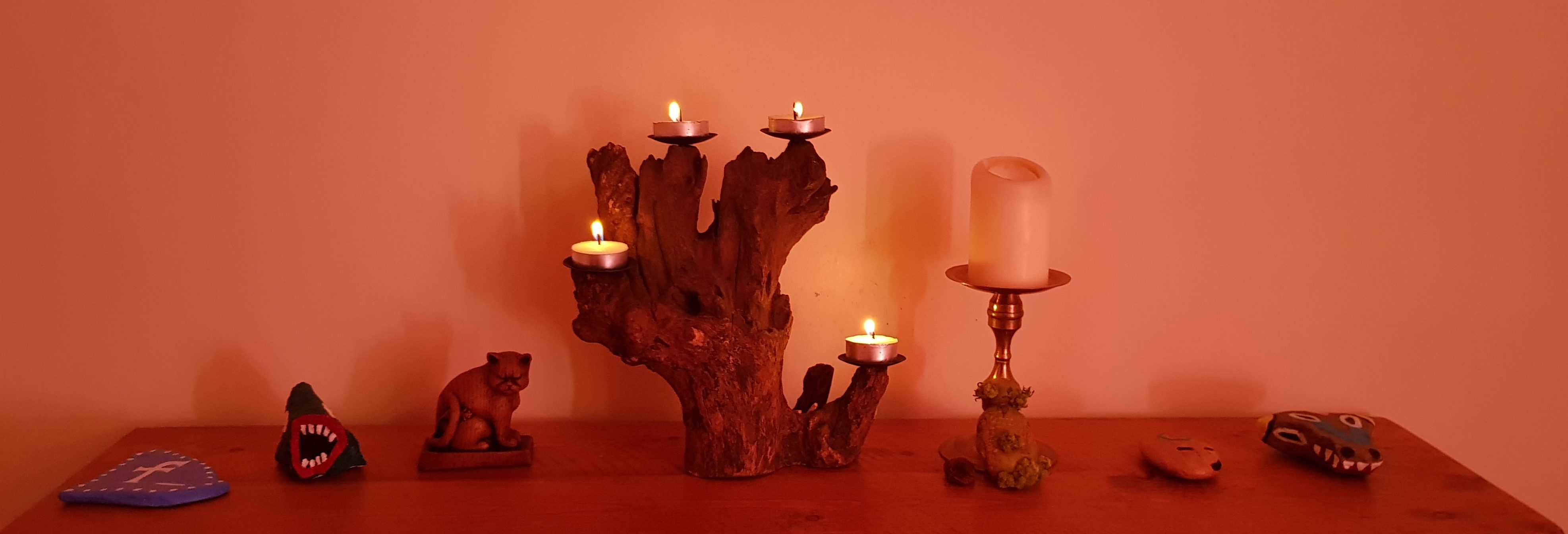
… the party meet St Nicholas (see picture). He is cheery on the surface but underneath he is seething, he has done nothing but give out gifts for thousands of years and has been sustained only by brandy and cookies.

He presents each PC with a present, each wrapped with string in bright, sturdy wax-paper:

  1. Brass bottle painted with a bright abstract design and the words “Henderson’s Excellent Temporary Tonic”. Makes you feel like you can do anything, that obstacles are just tissue paper, for an hour — have d6 temporary hp. Then it makes you feel like you can’t do anything at all for a second hour — have d6 temporary negative hp. (if you’re temporarily at zero or below, you’re basically useless for the period).
  2. Random spell scroll in an attractive leather case. (casts at user’s level)
  3. Leather-and-wood party popper that has the name of a random spell on the side – casts it when fired. Level 5 effect but targeting protocol is unclear to say the least.
  4. Handheld paper effigy of St Nick that’s full of something solid. On the back it says “Drive back the dead this festive season”. Has a fuse coming out of his head, and if you light it the whole thing burns for one turn and no undead below 4HD may bear being within 20ft.
  5. Disposable hand-cannon (30’ range 2d8 damage, one use only)
  6. A fluffy white kitten in a Santa hat. Quite clever and helpful but oh so very vulnerable.

He does not give hirelings or retainers anything — it turns out they have not been good.

He is accompanied by four

St Nicholas’ ReindeerHD 2, AC 12, move 50ft fly 60ft, ML 8, bite d6

Much antlers, much fur, much… teeth and claws? Make a lot of mouth-sounds that are suspiciously like talking. If they are talking, they’re making a lot of insinuations and jibes. Will try to steal things and would quite like to eat you (but St Nicholas will stop them).

At each location

In every scene and/or encounter, roll d12 once on this to add Christmas flavour.

1d4 Christmas stockings, roll d6 for each:
1-3 d6*10 coins
4-5 d6*10 ordinary stones
6 Fat muscular worm with a face, Dex save or d3 bite damage
7A crashed (non-flying-type) sleigh. There the body of a sturdy farmer under the sleigh and wrapped gifts in the back. Gifts are consumer durables worth d6*20 coins but if you take any the farmer’s ghost will follow the PCs and harass them until they make amends.  
2Everything is candlelit, even if outside8Something ate a reindeer here. they did not eat it neatly and they left the bones behind
3It is particularly snowing now. Useful visibility is about 30ft.9St Nick is here too. “You again?”. He throws coal at you and a reindeer tries to steal a backpack.
4D3 more of those reindeer, as weird as the first time and with St Nick to rein them in10Children here, singing. They run away if you try to interact.
5A random magical treasure in a gift-wrapped box. It’s in the possession of any monster or NPC that’s here,11A nativity scene. The saviour is in the manger and the magi look on. Does it move when you’re not looking? Surely not.
6Holly tree at the focal point12A fat turkey gobbles about here. It’s wearing a little backpack containing sausagemeat, sage, breadcrumbs, and two onions.

Lunacantium — players overview

This is the blog post where I will keep an overview of Lunacantium, my current adventure design project. Lunacantium features briefly in A Broken Candle, as the late and lamented capital of Rocaine, but I’ve never developed it in detail until now.

Lunacantium will also be my project for #Dungeon23, which I intend to do for at least a single day. I’ll put a warning at the top of every post so that current or potential players don’t see the secrets and thus ruin their joy and horror of discovery in-game.

Lunacantium, in play, is an OSR-style city-megadungeon. For three hundred years it was the glory of the nation, perhaps of the world, and then a century ago it collapsed. What remains is a dangerous ruin surrounded by mile upon mile of unlivable wasteland.

For rules I’m using Architrave, my lightly-reworked version of Knave 1e. I’ll probably put it up here at some point. Some assumptions (e.g. the very particular spell list) will set it apart from other OSR games.

What kind of game do I run with it?

  • There is a pool of active players, there are game sessions as and when (GM availability is probably the main constraint), and there is a (ruined) city waiting to be explored.
  • There is no plot. The story is about some people who went into Lunacantium and things happened there..
  • By all means roleplay your character as you see them. But I’m not going to target your character’s stories by e.g. setting up events that challenge their beliefs — you’ll have to make your own stories using the world as you find it.
  • I won’t scale encounters to the party, and I won’t fudge die rolls to save you. You’ll need to learn about the city and its dangers, and make sound judgements.
    • NB there is no at-all-straightforward resurrection magic
  • I will, however, strive to make it possible to read situations, to learn the nature (and risk level) of different areas, and to know when you’re getting into real trouble.
  • I may fudge rules for speed of play, particularly near the end of a game session.
  • I’ll probably run this intermingled with other things for a good while, but at any time it could disappear or be replaced by something else.

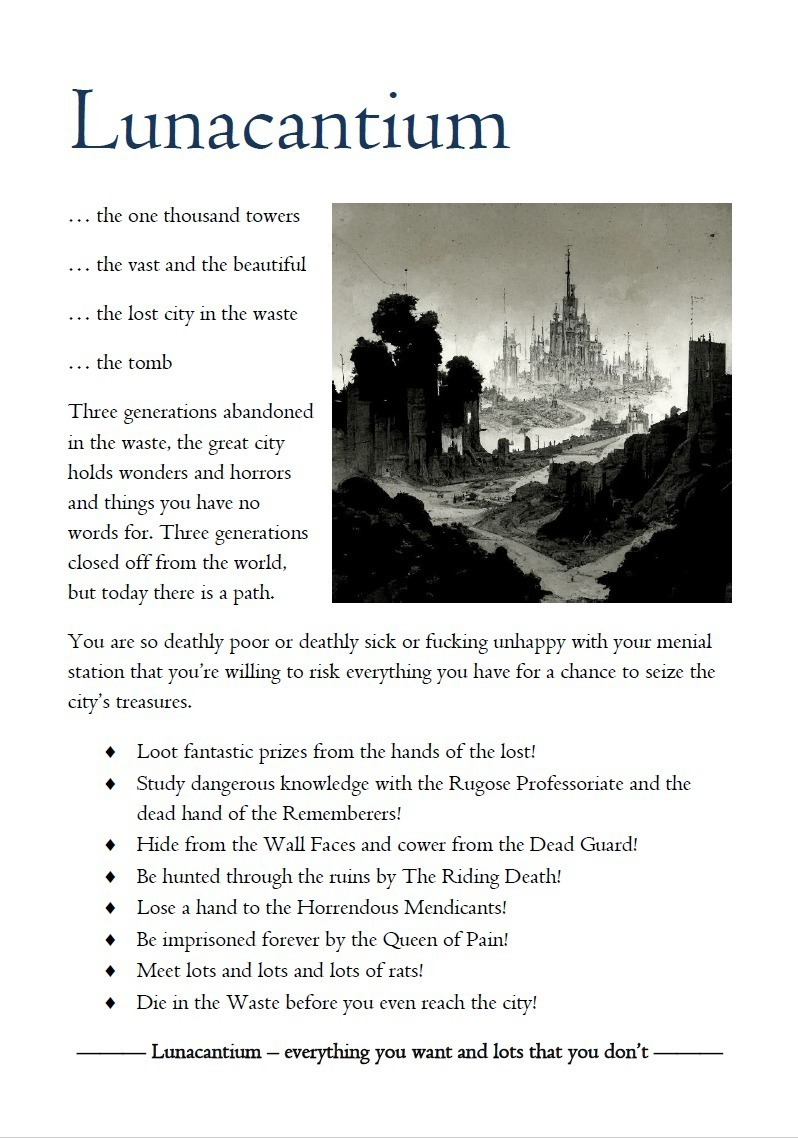
Finally, a promotional flyer:

A Manola-esque cut-down spell-list for Knave

Joseph Manola has an article on “game-enhancing” and “game-ruining” powers. By “powers”, he largely means spells, but also magic item effects. He presents a list of some types of powers that game-enhancing — that “facilitate creative and intelligent play” — and some that are game-ruining — that have the potential to short-circuit many kinds of interesting play.

A “game-enhancing” example:

Levitation: Slow, vertical-only flight. Allows for all kinds of ingenious problem-solving but requires careful set-up, not particularly useful in combat, and generates hilarious mental images, especially if you allow levitating characters to be moved horizontally by party members pulling them along on ropes from below!

http://udan-adan.blogspot.com/2021/10/game-enhancing-powers-game-ruining.html

And a similar but “game-ruining” one:

Unlimited flight: Trivialises too many kinds of obstacles and opponents, especially if it comes with perfect manoeuvrability as well. If you want to give your PCs access to flight, try to build in some serious limitations.

http://udan-adan.blogspot.com/2021/10/game-enhancing-powers-game-ruining.html

I have taken Manola’s article, turned it into a checklist for filtering spell lists, and applied it to the Knave spell list. I’ve also made a few cuts and changes for idiosyncratic reasons that aren’t on the checklist. It’s my list, after all.

I’ve done this for my games, which are low-level, low-fantasy, and rules-light via Knave. The resulting list is going to be utilitarian, it’s going to lack much of the magic from fiction, and it’s not going to be perfectly compatible with published modules. But it’s likely to work for me with most of what I do. If you are not me, or you are doing something else, it might not work so well.

First, my checklist:

  • Does it overlap with a key ability of another class? If so, cut.
    • (Knave is classless, so this doesn’t matter here, but in games with classes niche protection is important — otherwise, why have classes at all?)
  • Is it a direct attack spell? If so, cut.
    • (They’re boring, overlap too much with combat skills and weapons, and well known for contributing to the “quadratic wizard” problem.)
  • Is it something that can be duplicated by other reasonable, portable means, using the technology of the campaign setting. If so, cut.
    • (If magic replaces equipment planning, why bother with equipment?)
  • Does it greatly weaken, or outright negate, the most powerful and meant-to-be-frightening threats in my games, in particular undead? If so, cut.
    • (I’m very, very into undead. But many D&D editions, in particular OSE RAW, give Clerics powers that wreck them easily.)
  • Does it allow resurrection or straightforward access to the mind of a dead person? If so, cut.
    • (A key thematic element in the metaphysics of all my games is that death is the end — once you’re properly dead, you’re gone.)
  • Does it allow mind control, mind reading or lie detection? If so, cut or at least severely constrain.
    • (Mind control can kill the social element of play, while mind-reading and lie-detection can slice through mysteries with little effort or interest)
  • Is it otherwise Manola’s list of bad things (unlimited flight, unlimited intangiblity, mobility-while-still-attacking)? If so, cut or at least severely constrain.
    • (See Manola’s article for individual rationales)
  • Is it simply too powerful for low-level Knaves to use safely, given the general feel of my worlds? If so, move to greater magic list (and give it a risk you run whenever you cast it).
  • Does it provide a versatile building block for use in adventuring tactics, gambits, or plans? If so, try to keep. (narrow and restrict it if necessary to achieve that)

Second, the spell list, with commentary of what I’ve cut and why, is on its own page.

Finally, do you want a diegetic rationale for having such a limited spell list? For Knave, I say this:

In theory, magic can do an infinite variety of things, but in practice the vast majority of what you try achieves nothing at all. Scholars and seers and holders-forth-in-lecture-halls promote general theories of magic, not of which hold water beyond a very narrow scope. Most spells have been handed down from the distant past and at best been tweaked by modern practitioners. And you, as a Knave, are a pretty borderline practitioner.

So, anyone got thoughts?

(My main concern is that the resulting list is dry and utilitarian. But, then, the Knave list was dry to start with, partly because it’s so short. The best way to fix this is probably to add concrete detail of supernatural character — not just “An object of any size is pulled directly towards you” but “Four ghostly hands grip and object and pull…”, not just “L+1 objects are strongly magnetically repelled from each other” but “L+1 objects are possesed by animals spirits and write in disgust and pull away from another…”. That will take more space, but will make for better spells.)

Two more thoughts on beauty in Ynn

I’ve been re-reading The Gardens of Ynn, to understand how it achieves beauty and simple pleasantness. I put most of my thoughts in a previous post, but here are a couple more:

  1. Even the killer spores (p17) produce delicate flowers.
  2. A “brilliant rainbow of colours” in the silk garden (p18) — explicitly “brilliant”, rather than “garish”, or “clashing” or just flat “rainbow” leaving you to make your own assumptions.
  3. The interior of the ruined tower is decayed, yes, but that decay is understated, mundane, more nostalgic than unpleasant:

The interior is dusty, cobwebby and falling apart. Wallpaper peels from the walls, the carpet is mouldy, and water pools by the shutters.”

(p22)

An Anki deck for OSE / BX D&D

I’ve created an Anki deck for some details of BX D&D, using OSE as my reference. I’ve only covered those things that I found difficult to remember, which I suspect are “those things where it differs from Lamentations of the Flame Princess and/or 3e or 5e”.

You can download it as a zip file here:

(that includes a text file with all the cards, one per line)

How beauty is achieved in the Gardens of Ynn — initial thoughts

I’ve written some OSR modules, and I think I’m pretty good at invoking ruin, horror, and threat in text. As far as I can tell I’m doing that in a way that would let anyone running those modules invoke that in their descriptions, too. This seems to be a common skill, at least amongst OSR module writers.

What I’m not so good at is beauty — the attractive, the desirable, the sublime. And that’s a skill that I’d like to develop more. It’s very easy for OSR-type modules to become relentless dark and grim, and therefore monotonous, and I want to contrast that with more positive emotions.

So… I’m looking for examples of beauty in adventure module text, to read and learn from.

I started a thread on /r/osr, and one recommendation was Emmy Allen’s The Gardens of Ynn. I’ve read it before, run two sessions in it, but hadn’t thought about it as an example of this. I’ve started to re-read it, and have some initial observations:

1. Allen is explicit from the start that beauty is her aim, even tho it’s a squarely OSR module:

I wrote this to get out of a creative rut, liked what I’d produced, and made it pretty. I think it’s easy for games to push in darker directions, and to match the unpredictable lethality of old-school games with a particular grim and gritty aesthetic. I wanted to move away from that, into something that, while not blandly pleasant, had a lightness of tone to it. A setting where sunshine is the default weather.

(p5)

2. Its main tactic seems to be simply describing pleasant things — manicured lawns, herbs in raised beds, a trellis of vines that produces dappled shade (those are all from p14).

3. To complement that, there isn’t much horrible here, at least in the first few locations. I.e. some of the effect is achieved by the absence of unpleasant things. IIRC there is an low (though nonzero) proportion of gore and horror throughout.

4. The writing isn’t particularly fancy — it’s quite prosaic and economical. At no point does it push to be evocative and overshoot into verbiage or cringe. It presses a few buttons in the reader and then the reader does most of the work.

5. The tone is lighthearted, not serious, not ominous. For example:

Gazebo

A jolly little wooden pavilion. Bright paint faded and peeling. Within, a few wicker chairs and manky cushions. Cobwebs, perhaps. Knickknacks such as teasets, decks of cards, opium pipes, worth d10+depth gold, plus roll for treasure.

(p16)

6. As an enabling tactic, it does seem to assume sunny daylight at all times. Though it doesn’t quite follow through with that — there is a day and night cycle described on p9 and weather-change event on p12.

The Bone Place of Dreib – out at DTRPG

I’ve just published my third adventure module — The Bone Place of Dreib. It’s currently $3 at DTRPG.

Back cover blurb:

You are alone. It is dark. You have never read a book.

There is something in here with you.

On a hill above a deserted road there is a rocky crown, and in that crown is the Bone Place of Dreib, and in the Bone Place (so you have heard) is a temple of the ancients full of treasures wondrous and diverse. Why it is unlooted and undefiled? Probably the stories about the place, the ghosts that come if you sleep too close, and the list of grave-robbers who never came back.

But the stories are probably bullshit, the ghosts probably just nightmares, and the grave-robbers rank amateurs. You are don’t care about that shit.

And you have this dream every night. A dream that you are alone, that it is dark, and that you have never read a book. You are down there in the earth and there is something in there with you. It is a million years old and it is not your friend.”

It’s built using Old-School Essentials as the rules reference, and I’ve roughly tuned it for 3-4 PCs of 3rd to 4th level.

This one has been a haul — I was doing preparatory reading (on funerary rites and on the prehistoric world), working on it seriously (there are computer files) back in July, and had a playable sketch by the end of August, but the playtest-and-revision cycle took months. Largely this was the pandemic-related difficulty of getting people physically together (I have had it with online play). But now it is done. You can be the judge of whether it was worth it.

Examples of things that support Foreground Growth

I’m currently into Chris McDowell’s idea of “Foreground Growth” — character change and advancement because of specific things that happened in play, with no metagame rules invovled. Partly this is because I’m running Electric Bastionland and thinking about running Cairn, and neither has traditional advancement rules. The problem is that it’s not always obvious how to make it happen — while XP and level and skill point and advancement systems guide you to use them, foreground growth is something that the GM has to support.

So I’ve started a list below of foreground growth opportunities, along with sources that say how to do this or that glisten with examples:

Here are, also, some examples of foreground growth that don’t fit into the above categories (thanks to Yochai Gal for pointing these out):

If you have more categories, or can point me to more good examples, please let me know in the comments and I will expand the above.