FORGET HNN, HERE’S THE REAL NEWS IN 15 SECONDS:
- The 51st Legion have blockaded the Church of Stellar Flame’s cathedral ship in its orbit around Iota. Good sources say the Church has the Aleph Key. Trusted insiders says Governor Ritam al’Malklaith ordered the blockade.
- Meanwhile, a number of formerly-senior Legion officers have taken the hard way down from the Scorpio’s geostationary orbit of Aleph to the rocky planet below. Looks like there’s some house-cleaning going on.
- While the cat’s distracted by other matters… The Ashen Knives have decapitated four major crime syndicates on Warren. They’re on their way to owning the black market throughout the Rin system. Does Malklaith care? Does he fuck.
REAL ACCURATE NEWS — NONE OF THE BULLSHIT
Author: robdalexander
News in Immergleich, 6 June 936
“The gang war is over. Yesterday, members of Kylissa’s gang paraded through Pitside with the the head and hands of the former gang boss “Joke” (real name Wieverd Kimpsil). Kylissa now appears to be unchallenged in her control of the district. Rumour has it that she plans to …”
“… and following on from the VIOLENT DEATH of Myxilla von Korp, the notorious PERVERT Sedgins von Korp has VIOLENTLY DIED in a fall from the underside of Immergleich Prison, ending up SMASHED TO PIECES on the rocks 800 feet below. … An anonymous source sympathized with the TEXTURE OBSESSED weirdo — “I mean, dude just wanted to touch your rusty copper kettle, and maybe the wool of your tunic. He never meant any harm.” “
“… neither Disilla nor her son Azad, the usual public faces of House von Korp, have made a public statement on these events. However, rumour has it that they will pay good money for the information on the whereabouts of a large man with a red devil mask and a remarkable bone club …”
Working with the Design Space of a Tabletop RPG’s Resolution System
I want to make decisions about the main resolution system for a game I’m designing, but feel stymied because I don’t know what the relevant design space is. I don’t feel confident that I know the questions I can usefully ask. You can see a similar problem (while designing a different game) in my previous posts Combining Dungeon World attribute checks with LotFP skills, badly, and in Some numbers for Dungeon World rolls with LotFP skills — I’m coming up with ideas, and generating some stats about them, but I don’t have any clear idea of my goals so it’s all a bit aimless.
I want to know:
- What is the space of plausibly-useful resolution systems that I can use for a game like the one I am designing?
- How can I “navigate” that space for a particular game so as to home in on the system that gaves me game behaviour I like?
Continue reading “Working with the Design Space of a Tabletop RPG’s Resolution System”
Szamitir, a large island
From “The World, Shaped As It Is” by Quentiby Firlmortar, Immergleich School of Acidic Patterns
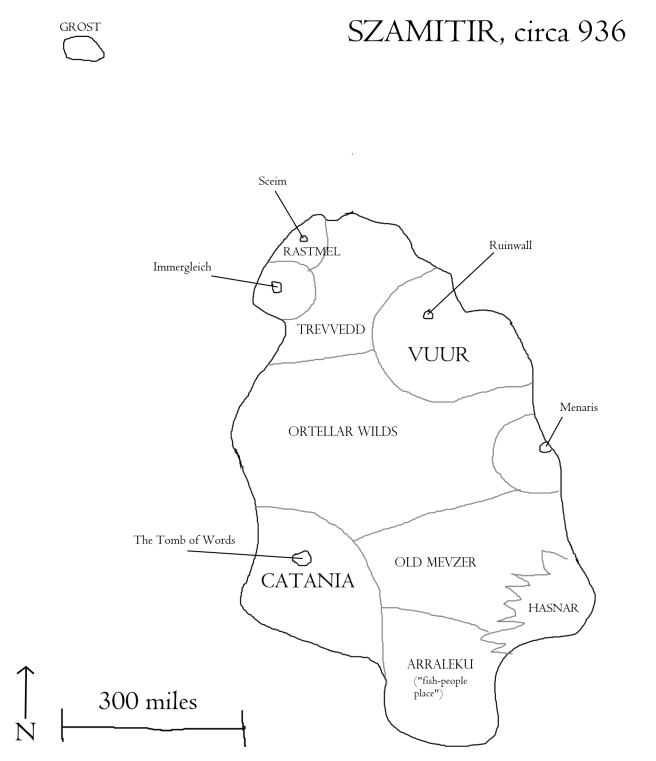
Szamitir is a large island, varied in climate and people. It is customarily divided into the several regions of greatly varying stability, prosperity and potential for the future.
Arraleku
This is the home of the fish-people. No-one should go here.
Catania, the Serene Republic of
Under the watchful eye of the Sorcerer-Queen and her Arbiters, Catania enjoys a blissful peace in a land of gentle rolling hills, bucolic villages, and pastel sunsets. A model, perhaps, of what other nations could become.
Simple random attributes lead to average characters?
Jon Spengler says in Rolling D&D Stats is Bad For You, a Reprisal that standard rolling methods generate a lot of mostly-average characters. I.e. many chars with all their attribute close to their overall mean. In contrast, assign-an-array methods tend to give extremes — characters who are strong at one thing and weak at another. And thus the latter is usually better for play.
My instinct was that he was right, but I decided to put some numbers on it to check it, and so that we can measure how much difference the various creation methods make.
Continue reading “Simple random attributes lead to average characters?”
On-the-Fly Dungeon Generation Using The Perilous Wilds
The Dungeon World supplement The Perilous Wilds has an on-the-fly dungeon generator, which I use as part of Low-prep dungeons — a larval proposal. However, despite its CC-BY-SA licence, the text of that has not been available in a editable format. Until now. I have extracted the text of the dungeon generation system, converted it to Markdown, and put in online as a GitHub project.
If you just want to use, not to edit, you can download a basic PDF render of the text.
I’ve left some “see page XX” cross-references in the text, as I don’t know what best to do with them (other than pulling in text that they refer to). For now, I’ve replaced them with “CROSSREF”.
Letter to Thorgrim from Azad von Korp
Letter received by Thorgim on 14 May 936 —
Thorgrim,
I was pleasantly surprised to see you escape my prison, although after our little duel in the Warrens perhaps I should not have been. You and your associates are clearly potent, and clearly quite hard to kill. It would have been easier for me if you hadn’t taken out Octon’s prize creation, but then the horrid old bastard will be completely solid soon and I won’t have to listen to him.
With regard to “the experiment” — you are missing the plural. That lower dungeon level contains “The Experiments” — mostly Octon’s, but a few happening under my supervision. I keep my eye on practical use, while he just likes to fuse things onto other things.
Anyway… I have a job for you, on terms that you may lke. My spies have discovered that House Zuxian are keeping something very special in a tomb in the Resting Field. Small groups of Zuxuan notables go pack and forth, muttering about how “Gorin won’t like his suggestions”, and “It’s ok about the stabbing, none of us can keep him out of our minds”, and “If I were in charge, I’d just let him die”. I don’t know about you, but that sounds exciting. I want it.
Now, after all the House Verdun trouble we’re all about as popular as Sedgins is, so Disilla is extremely tetchy and very conflict-averse. And unless that hole gets a lot bigger, we’re stuck with her. So I will pay 500sp for retrieval of this thing, but it has to be discrete — no-one can know that I have it. I’ll pay half on delivery, then half two weeks later if those Zuxian weirdos aren’t on my ass about it.
How does that sound?
Azad von Korp
The Gallery Rises
Immergleich Bleak Herald, 12 May 936 —
“… the Head Curator, Petrovel Clawns, denied that such a transformation is exceptional — “Every painting is alive, if you think about it, through its function on our minds and its impact in our lives. This is just paintings being alive when no-one is looking at them, turning on their creators, and wreaking havoc.” Then she gave a funny little noise.
No-one knows why the Shattered Gallery’s paintings, sculpture and pottery have come to sudden life. No-one knows why the places depicted have become more real than the spaces they were kept in. No-one knows what has happened to the 22 nightwatchpeople, cleaners and late-working curators who are believed to have been in the gallery on the night of 10 May. No-one knows what has happened to Forrus Verdun and his six retainers, who went into the gallery yesterday and haven’t yet come back.
What everybody does know is that, right now, art in Immergleich is best appreciated just about anywhere else.
Some valuable insights into OSR play
I’ve recently read a thread at storygames about motives and methods for “OSR” play that make a lot of sense to me — “Let’s talk about how OSR-style mechanics work“. If you don’t understand OSR play, or you don’t understand why a game involving a lot of GM judgement could be consistently enjoyable, the whole thread is worth reading.
I found one comment by Eero Tuovinen particularly enlightening. It succintly captures a common weakness in people’s understanding of GM authority. Key quote (emphasis mine):
“[The role of the GM in OSR D&D] has often been characterized in Internet discussions with extremist positions that obscure what seems to be really going on: both the “D&D can’t work because it’s impossible to be impartial and the players are deluding themselves” and the opposite “it’s the GM’s game and he’s got the viking hat and if you don’t like it you don’t have to play” positions ignore how much trust-building, hygienic practice and accountability goes into refereeing old school D&D.”
Immergleich rules update — attributes, skills and hit points
I’ve implemented some significant changes to Immergleich’s rules. They affect three things – attributes, skills, and hit points.
Attributes are now attribute modifiers
D&D characters are succinctly described by their six attributes (strength, dexterity, etc). it’s easy to make lots of rolls using just attribute values. Creating them randomly gives you a possibly-surprising character to play, which is fun and a challenge. But the raw attribute values (3-18) are very rarely used, and they don’t improve through advancement at all.
Continue reading “Immergleich rules update — attributes, skills and hit points”
 The Wrong Kind of Wax