Things to run in two hours or less

I have been busy, recently, and expect to remain so. There is a new child in the house and she makes continuous infant demands. It will be hard to find gaming time and harder still to be consistent. If I am going to run games, even organise GMless games, they need to be low-prep and one-shot-compatible.

Worse — my gaming sessions are habitually week nights, seven thirty until ten, which gives two-point-five hours of which we can rely on two to be on-topic. That’s tight. I don’t mind that — with the kind of games I GM (low ratio of rules time to creative time, high GM lift) that, and with GMless games that’s often plenty for everybody.

So, I want options for one-shots in that space.

But… you can’t be sure how long a one-shot will take. Some have easy flex (many GMless things), but some are in the hands of chance and player’s ultimately-tactical choice (most OSR things). So I want some things that can fill out a session that ran short, filler things, sub-one-hour options.

So, lists. I might even update them over time.

(In the below, anything is normal text is something I’ve run before; anything written like “?? thingname” is something I haven’t tried yet.)

OSR stuff

One thing common to all of these — even with the lightweight rules I tend to run (Knave, Cairn) — is that character creation can greatly eat into two hours. So it’s pregens all the way. Often effortful, unfortunately, if you want sensible ones above first level.

Medium-and-up OSR dungeons that suit two-hour raids

  • Stonehell
  • Hole in the Oak
  • The Gardens of Ynn
  • Through Ultan’s Door
  • ?? The Stygian Library
  • ?? Gradient Descent (for Mothership)

Small OSR sites that are “completable” in two hours

i.e. the players can, potentially, see all the interest in two hours. No guarantees, of course, They might just die.

  • ?? One-Page Dungeon Competition Winners
    • (Downsides: will tend to need some prep work tho, as often generic or unstatted; short-form presentation doesn’t necessarily mean short play time)
  • ?? Michael Prescott’s “Trilemma Adventures”
    • (Downsides: one- or two-page presentation may mean high GM lift, and that presentation doesn’t necessarily mean short play time; unstatted, though the closest-system Trilemma Bestiary may help)
    • NB these are free online, but the version in his published Trilemma Compendium as apparently revised ones
    • Skerples has helpfully reviewed every adventure that’s in the Compendium — I’ve only read the ones he marked “good”
    • My list to try, most interesting first:
    • ?? The Full-Dark Stone
    • ?? The Coming of Sorg
    • ?? Sirens of Blood and First
    • ?? Do It for the Beast
    • ?? The Sorcerer’s Feast
    • ?? The Task of Zeichus
    • ?? Midden of the Deep
    • ?? Basilica of the Leper Messiah (atmospheric and distinctive, but not very clear how to use)
  • Nate Treme’s pamphlet adventures
    • (Downsides: short-form presentation may mean high GM lift, and that presentation doesn’t necessarily mean short play time; some minimally statted)
    • Temple of the Bat Serpent (tried — took two hours to explore half of it, but we may just have been slow)
    • ?? Barrow of the Elf King (free)
    • ?? Witchtomb
  • Assorted very small sites by diverse hands
  • Make my own using the five-room dungeon model
  • Make my own using no particular model
  • Make my own using ?? other model

OSR encounters or locations that are likely to take under an hour

  • Just roll some random encounter (particular on a table of specific detailed ones)
  • Make my own list of encounter ideas (easy to rattle off a few in a sitting; an easy way to be creative)

GMless and weak-GM games

  • Swords Without Master
  • Lovecraftesque
  • Inspectres (or InSpace or my own In the Land of Old Magic)
  • Fiasco (think I’ve played enough for one lifetime, though)
  • ?? Follow (have played it once, but can’t remember much)
  • ?? The King is Dead
  • ?? Annalise (not primarily for one-shots, but has some advice on doing it)
  • ?? Witch — the Road to Lindisfarne
  • ?? Psi*Run (I’m told this works well in very-short form)
  • ?? Hot War (ever-popular for convention one-shots, tho not sure about two-hour format. Quite old now, probably rather janky, new edition coming soon with modern design.)

Sources

Ideas from the above came from sources including:

  1. https://www.reddit.com/r/osr/s/zXphoy3Jdm
  2. https://www.reddit.com/r/osr/comments/11khcec/how_much_stuff_to_put_in_a_3_hourish_dungeon_for/ 
  3. https://www.reddit.com/r/osr/s/BdrqhTDo73
  4. https://www.reddit.com/r/osr/s/z5d3DgmPH1

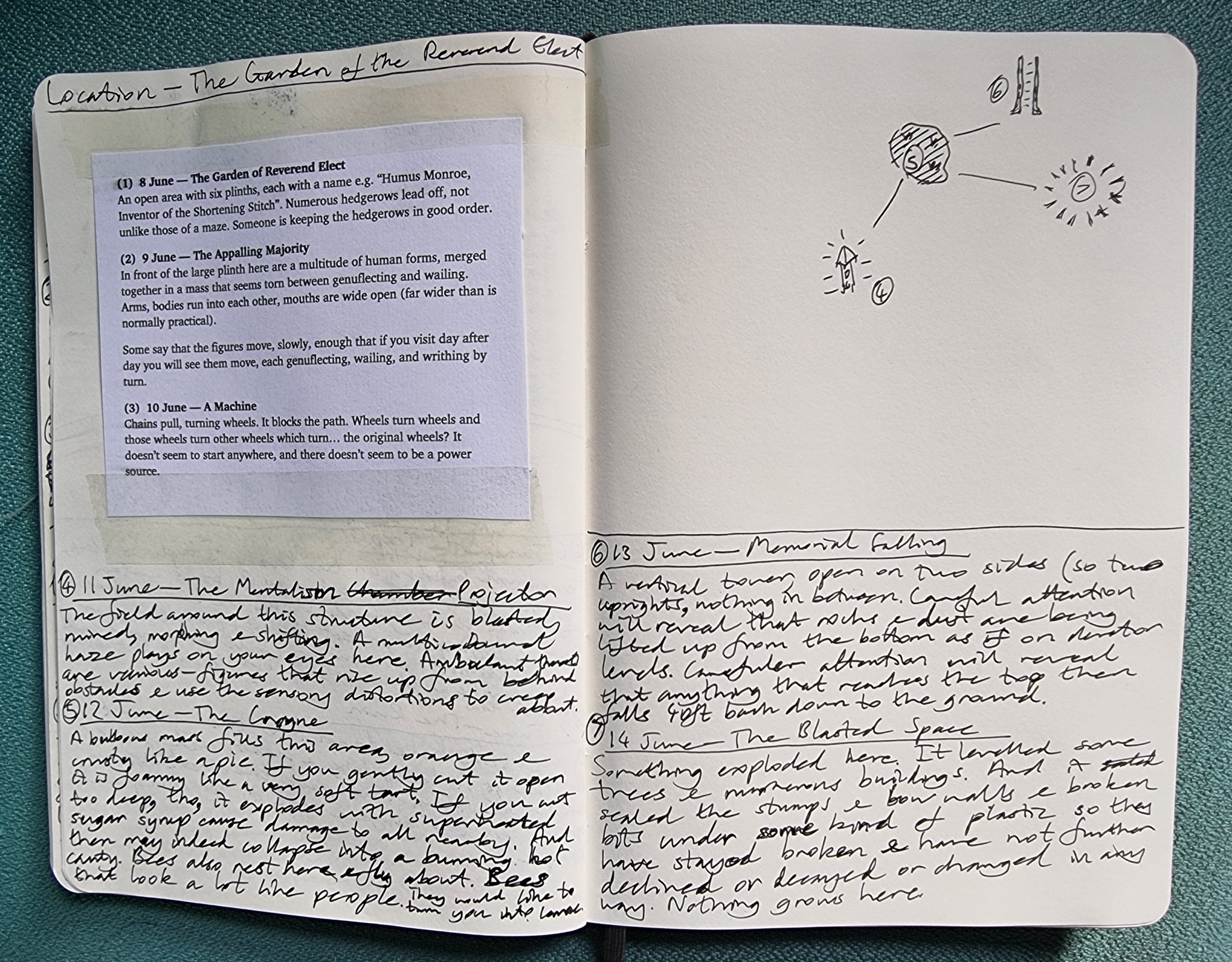
#Dungeon23 weeks 21 and 22 — The Forsaken Parish and the Garden of the Reverend Elect

I gave up on #Dungeon23 mid-June. It was an interesting activity, and I generated a lot of stuff. I don’t think I’ll use that stuff, however:

  1. After half-a-dozen sessions, I stopped running Lunacantium. It just felt… too cumbersome. I want to run and create things that are much tighter – more The Bone Place of Dreib than this. As Bryce Lynch is fond of pointing out, ruined city adventures are hard, and Lunacantium suffered from that. [1]
  2. The core Dungeon23 idea — keep making content, bit by bit — is at odds with how I create… pretty much anything. I write flash fiction start-to-end, but just about anything else I iterate, sketch, accumulate ideas (characters, locations, possibilities) without order or relationship. Only once I have a stable sketch and refined ideas do I put them together concretely, or flesh them out very much. I iterate; I don’t accumulate.

The upside here is that I’ve got enough rough content to fuel months of full-time work on Lunacantium, should I ever come back to it.

Thanks to Sean McCoy for starting the whole #Dungeon23 thing — it was, and remains, a good idea.


[1] I also think there was a tonal problem — something about Lunacantium never felt right to me. I think I was trying to do too much, create too big a thing, and that made control of tone, theme, and feel just too hard. My use of the Dungeon23 accumulative model, and that I was developing the two outer areas under pressure of play, probably exacerbated that.

#Dungeon23 weeks 13 & 14 — Pleasant Valley and Seven Pleasant Houses

Standard request to anyone who plays in my games, or who might play in my games — please don’t read this. You’ll grow a second butt.

I’m still going. Pleasant Valley is interesting, a second kind of “civilian undead” and possible a new leader, albeit and ineffective one. Interactions are interesting to think about… I’ve not really addressed the interaction between this and the Pain Maze to the south. And that maybe makes sense — cast the Queen as protector of the poor and downtrodden (have I done that? I think I cast her as more a pragmatic peacemaker) and cast the Covetous Survivors as the middling-rich who were terrified of that. Hence the fortification of the southern part of this district and the massacre scene on the bridge. Hmmmm.

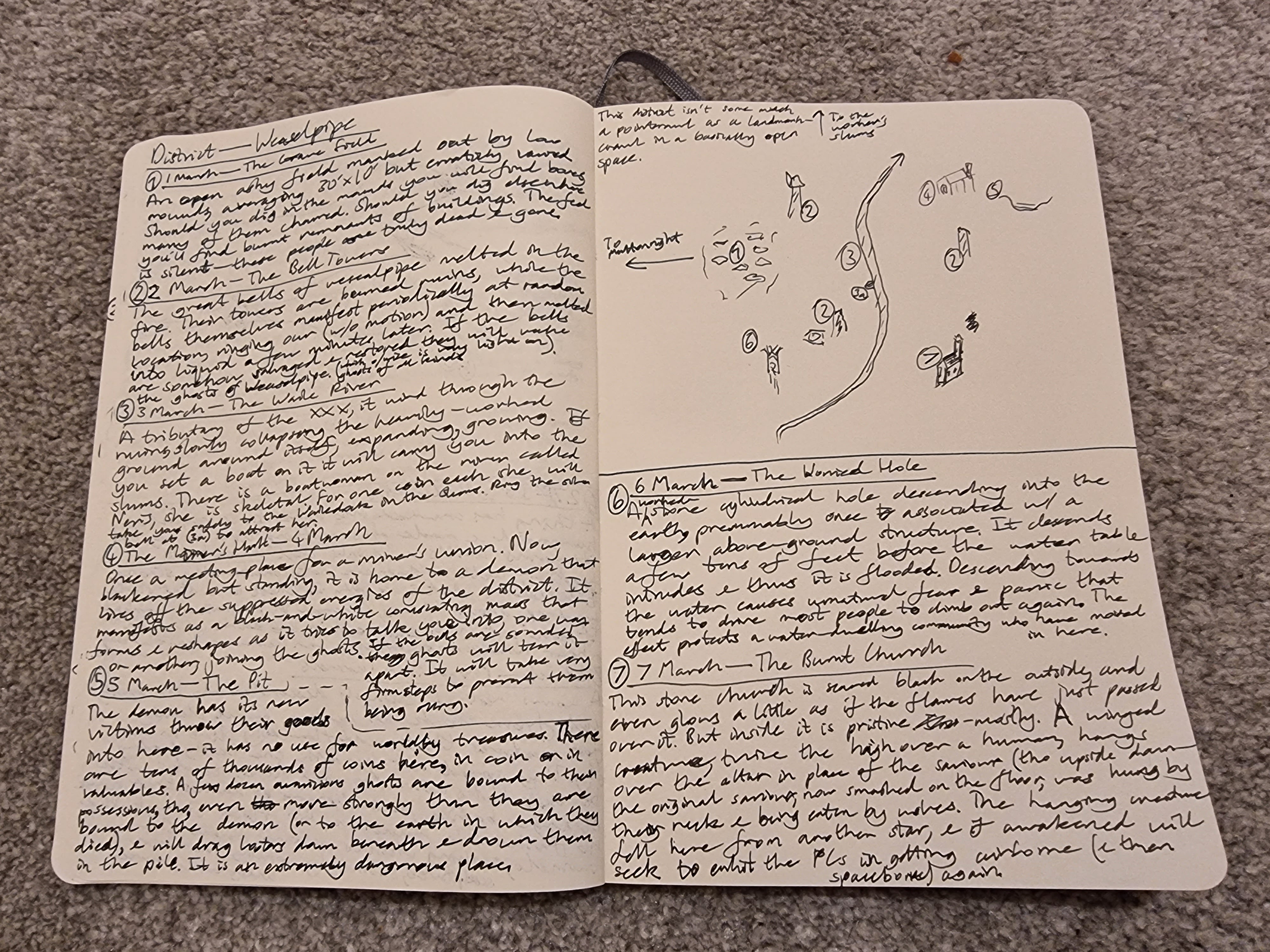
#Dungeon23 week 9 — Weaselpipe

Standard request to anyone who plays in my games, or who might play in my games — please don’t read this. It’s not right for you.

Moving on to a third district now. This is one I had only a vague image of, and the end result has been — patchy, but with some points of interest. Certainly there’s more going this district now than there was when I started, so that’s good. It’s by no means finished, indeed it’s barely helpful to adlib from, but it’s a lot better than a blank page.

I’m going to play around with how I expand this over the next three weeks… I’m not sure there are three locations here that need 7 sub-locations really. But I’ll probably try.

Should I run more Lunacantium in future, or even publish it, Weaselpipe might feature. And it might look something like this. Or only one of those, or neither.

#Dungeon23 week 5 — The Inner City

Standard request to anyone who plays in my games, or who might play in my games — please don’t read this. You’ll get the bends.

The Inner City is an important area, much more important than the Pain Maze is. It’s the heart of the city, topologically and topographically, and multiple city factions are or at least were based there. This was an area I’d sketched before, however, so the week mostly recapped that. Some nuances but fairly predictable I think if you’d read my other notes. It didn’t feel especially generative.

The next three weeks should be more fruitful, as I flesh out three of these locations. At the moment they are all just vague ideas.

#Dungeon23 week 4 — The Wintergate

Standard request to anyone who plays in my games, or who might play in my games — please don’t read this. It will ruin the joy and horror of encountering it the first time through your character’s eyes. Granted, it may shift and change before you ever see it, but why take the risk? Why risk the joy? The very joy?

The final location within the Pain Maze. More of a collection of ideas than anything coherent. Longer term, it’s maybe better to abstract movement through this one, rather than really map it – it’s not important enough for PCs to spend a long time in.

Next three days, I’ll do encounters or isolated features or npcs or something, then on the 1st of the new month I’ll move on to the Inner City district, which is much more important than the Pain Maze is. Not least because multiple city factions are or at least were there.

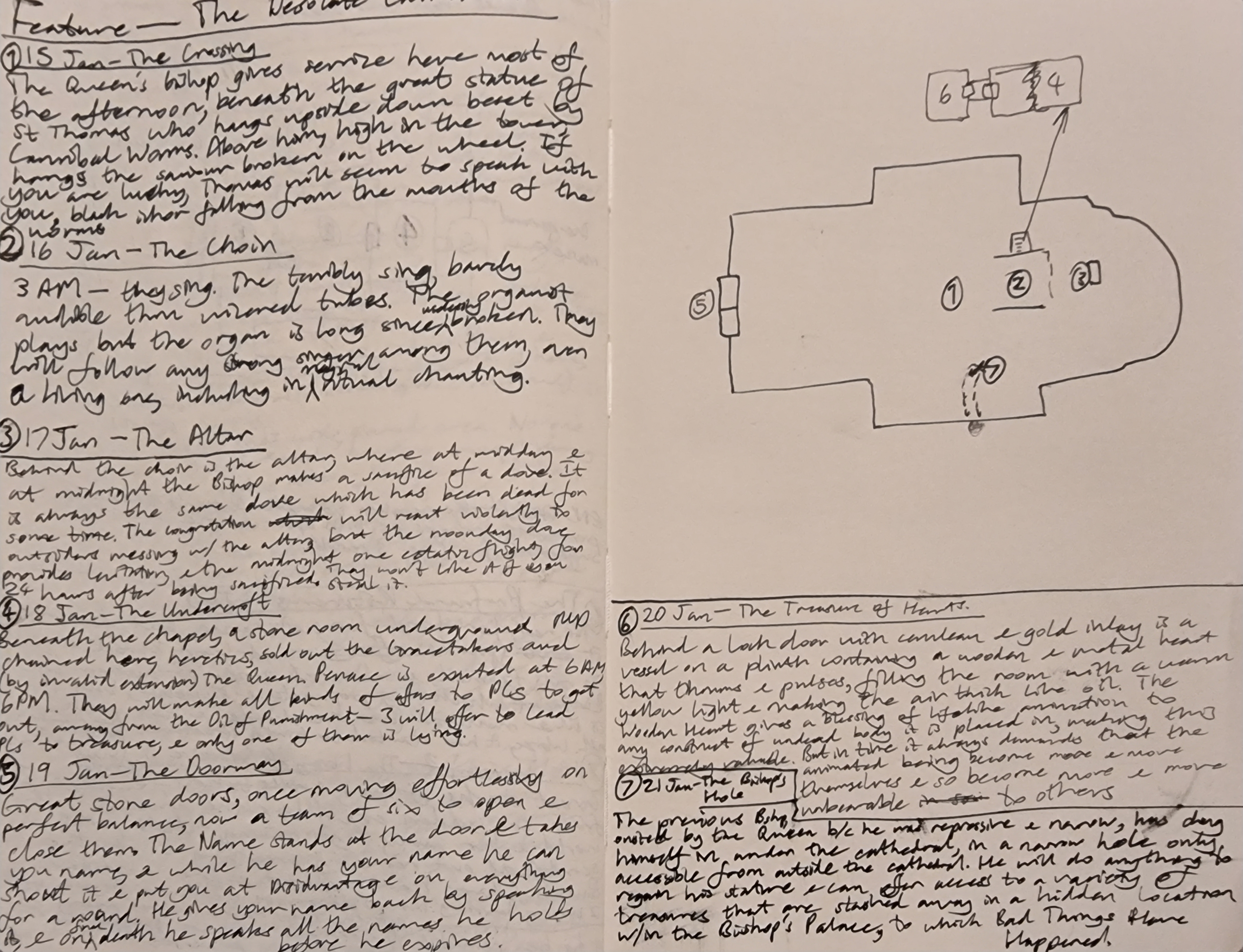
#Dungeon23 week 3 — The Desolate Cathedral

Standard request to anyone who plays in my games, or who might play in my games — please don’t read this. It might ruin the thrill of discovery. And that’s a high-grade thrill, hard to get in the open market.

Third week – another featured location within the Pain Maze. I like this one a bit more than the Winter Palace – it feel more concrete and interesting. Might be because it’s smaller, and thus the locations within it tend to be of more manageable size.

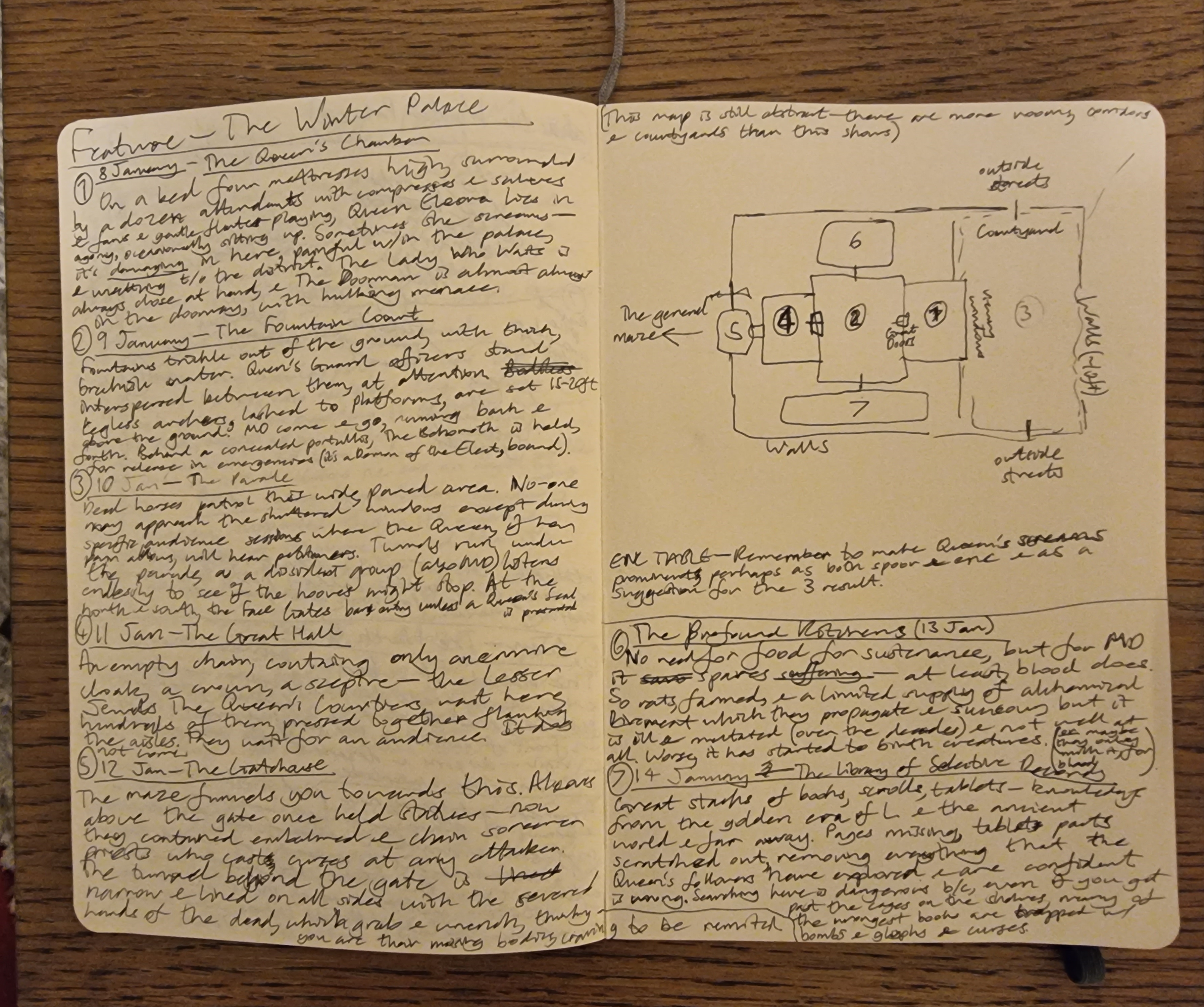
#Dungeon23 week 2 — The Winter Palace

I’ve done a second week of #Dungeon23.

Request to anyone who plays in my games, or who might play in my games — please don’t read this. It might ruin the surprise. You know you love the surprise.

This week I’ve found the stuff I’ve made rather boring. As you can probably see from the above, I’m working at a level between “district of a city” and “topographical map of individual rooms”. It feels like I’m making areas that are simultaneously too small (to sketch a palace using only 7 of them) and too large (to have interesting details).

I do wonder if staying at an abstract pointcrawl would have been better here — it would have encouraged me to think more about “what’s interesting in the palace” rather than “what’s interesting in this broad area that connects here“. Working with interesting points rather than major areas might have been more fruitful.

In any case, I don’t think that matters much — I’m not doing this to make stuff that’s good right now. I’m doing this to (a) have sketches to work from should I suddenly be improv-ing a group in thru of these areas and (b) get over the blank-page barrier and give me something to fix if and when I come back to these areas for serious design work.

And the act of doing this, repeatedly, is probably a good way to learn what works at this level of abstraction. So that’s also useful.

#Dungeon23 week 1

I’ve done a week of #Dungeon23.

Request to anyone who plays in my games, or who might play in my games — please don’t read this. It might ruin the surprise.

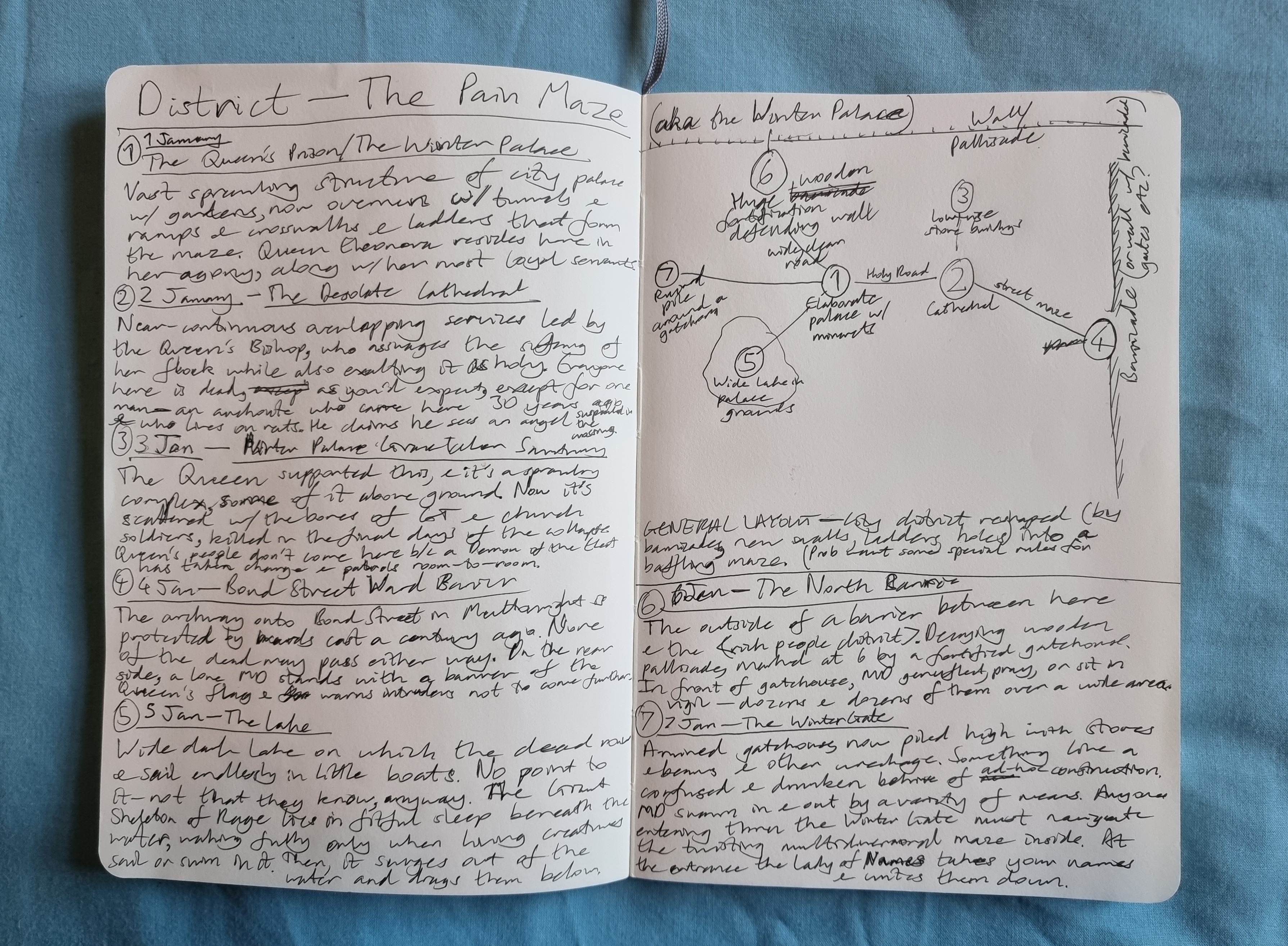
The context is Lunacantium — my current open-table game. This month we’re in the southwest district of the city, where the Queen had her Winter Palace and now lies in agony. Tragic figure, the Queen, tried to do sensible things, tried to stop the fuckstupidity, tried to broker peace, and for her trouble was poisoned by her husband and his co-conspirator the Archbishop. A further complication is that, having taken Communion with the Gracetakers, and with that being a bit more necromantic than they realised [1], the poison couldn’t keep her dead. She gets all of the pain, all of the time, forever.

She was beloved to many in life, and so still is in death. Her followers, themselves Meagre Dead from Gracetaker practices, have built a maze around her of barricades and walls and traps. They will let no-one get close to their Queen.

Will I do more weeks? Watch this space. If I do, I expect months to look like:

  • Week 1 — sketch a district in terms of seven key features
  • Weeks 2–4 — flesh out the three most interesting features, giving them seven keyed locations each
  • Any leftover days — sketch a few random encounters

Since I’ve already developed two districts for use in play (at the time of writing, I’ve run six sessions), the twelve months of 2023 should give me a rough picture of the whole city.

[1] I mean, pretty much entirely necromanctic and wholly divorced from the mechanisms used by established church[2].

[2] Notwithstanding that what those mechanisms are is itself quite unclear.

Thoughts on a game for 2023

I’ve been watching other people talking online about what they want to run, and I’m conscious that I don’t really have anything. I’ve been doing a lot of OSR stuff for years, but right now my interested in that is saturated by my Lunacantium open-table megaproject. I want to do something, in parallel, that’s different to that, and that is likely to be interesting to a wider audience of players. (OSR play, no matter how well done, is narrow in its appeal, both within and without “gamer” circles)

I want to return to my roots[1] a bit and do something in the post-Forge individual-PC-story-centric tradition. Something where each player makes a distinctive very motivated PC, where the players continuously use author stance to intertwine their stories, and where my role as GM is to help something interesting emerge from that. I’m thinking of games like Burning Wheel, The Shadow of Yesterday, and I guess Sorcerer.

Biggest complications:

  • I’m not really interested in PBtA — the obvious post-Forge choice — I want a universal resolution system, not a mess of distinct moves. (Think of Burning Wheel — there are principles for when you roll a Test and how you agree what the stakes should be, which the whole game then revolves around. I am extremely in favour of that.)
  • I want something that emphasises pace, while still giving the world and emergent story room to breathe over multiple sessions. (in particular, I don’t want any kind of very-extended combat, tho that’s probably a freebie in this design space)
  • I can’t get interested anymore in complex rules, except perhaps if I can explain what every little fiddly detail is going and why and why it’s worth players having to learn about it. (Hence I’m not interested in just running Burning Wheel — I never could understand why there was so much detail)
  • I don’t want anything that encourages system mastery — I want to be open to all kinds of players and levels of rules-engagement.

Big bonus if it’s no-or-low GM prep. I am cautiously open to GMless stuff, too (I’ve been having a pretty good time with Ironsworn co-op)

If anyone reading this has any ideas, please, the comments. In the mean time, I might tour this around the forums and see what ideas I get.

[1] Not my real roots — I got into rpgs when I was 7, and the Forge happened in my 20s. But it was Forge and the ideas around it that got me back into gaming after I gave up on it in college, and it did that by showing me what I wanted in the first place[2].

[2] To summarise that, briefly, I can mostly easily do in the negative — “not trad” i.e. no linear GM-written plots, high emphasis on player control of story, and player-in-PC immersion as merely a nice-to-have. Oh, and efforts to find the best value in shorter forms of play, with multi-year campaigns relegated to “well, maybe, that’s a thing you could do” rather than being the aspirational ideal.