
The War of Art

f356c762c2423c125b32784a45ee8d71

Interviewer: So, there’s trouble on the hill?

Confused woman: Oh, yeah, there’s definitely trouble.

Interviewer: On the hill?

Confused: Yeah. Over the Verdun estate, morning after Null Day. It was really scary.

Interviewer: What was?

Confused: The thousand foot high metallic-paint dragon. Terrifying.

Interviewer: This metal dragon, what did it do?

Confused: Got ripped up by the watercolour sky hands and the gouache demon-birds.

Interviewer: That was the end of it?

Confused: On no, it got much worse.


Backgrounds for Immergleich PCs


Mendel_I_092_r

Where did you come from? What have you done? Beyond those given by your class, what are your skills? You get to choose a Background for your PC, which can be any single trade or occupation name, which captures this. When you attempt a task that your Background gives you expertise in, you get a bonus (unless you’d get a bonus anyway because of your class).

A mechanically-useful background is one that complements your class, giving you expertise (and thus a bonus on an attribute check) where your class would not.

The game assumes that level 1 characters are net broke, apart from their initial money allocation, and do not have access to significant local resources. So if you define a background that implies such (e.g. “Merchant Adventurer”) then it is implicit that you have fallen on hard times at the point you enter the game.

Examples — scholar, mercenary, blacksmith, prostitute, noble, sculptor, chef, travelling tinker, farmer, galley slave, …

Decontention — when there are too many players, and none of them are demonstrably bad

For Immergleich, I set a hard limit of four players in any one session. I find that having five players makes the game noticeably lag compared to even the four player version. In contrast, I don’t notice much subjective slowdown when moving between three and four.

This raises a problem — if more than four want to play, who gets to? First-come-first-pleased is an obvious choice, but that’s too arbitrary. Instead, I propose a ranking system, where all the players in one rank get places before any in the rank below them. However, because I am a genius, even the ranking system has ranks. First:

  1. People who had the opportunity to state their availability e.g. via a Doodle poll (and thus enabled me to arrange a session at all) and took it
  2. People who did not have such an opportunity
  3. People who had such an opportunity, and cast it to the four winds with a mocking laugh

And then, within each of the above:

  1. Wanted to play in the last session, but were bumped (or willingly dropped out to let others play)
  2. New players
  3. Wanted to play in some previous session, but were bumped/dropped out, and haven’t played since
  4. Didn’t play in the last session
  5. Played in the last session

If we end up with an excess of players at the same rank (e.g. there are two at rank 5 for the last available slot) then tiebreak is first by total sessions played ever, and then random.


Some things that are against the law in Immergleich

815px-041A.Moses_Breaks_the_Tables_of_the_Law

  1. Selling things in the market without a Market Licence
  2. Riding a horse inside the city walls
  3. Wearing metal armour in public
  4. Casting of spells, magic and charms in public, where not warranted by the public good
  5. The practice of haruspicy (that is, the telling of fortunes by means of introducing beetles to the matter of corpses or, Gods forbid, some living unfortunate)

Implicit rider on each of the above is of course “… unless you are on-duty in the Watch, a noble, a retainer of a noble house, otherwise very rich or acting for someone very rich, or visibly of terrifying potence”.

Some random noble houses

Here are some ideas for noble houses, mostly ones that were too weird, or not weird enough, for my city of Immergleich:

  1. Literally think they’re animals
  2. All look the same. Different ages, different sizes, different sexes, but same faces and same basic shape.
  3. Represented by porcelain golems with exaggerated features. Nobody knows what the real nobles look like.
  4. Have given up on their line, as they cannot breed (or never have live births). They have made tombs for themselves, and live in them.
  5. Are not human and cannot be seen.
  6. All blind – use another sense as a replacement.
  7. Tend bizarre sea creatures – tanks are in every room. The sea creatures are mostly running the show, controlling the human through hormones and drugs they secrete into the water.
  8. Degenerate and ageing out – still powerful, but they have to share hearts, eyes, teeth etc as there are not enough to go around.


The Five Courts of Immergleich

The Court Physical

Steel.

  • Concerns – matters of the body, and harm thereof.
  • Court dress – dull grey, no headgear
  • Trials by – physical contest (you can appoint a champion)

The Court Spiritual

Twelve Temples.

  • Concerns – Relating to the gods, their worship and appeasement.
  • Court dress – Judges wear pure white, with red detailing. Others same, but no detailing. Prosecution, defence, and their advocates etc wear sackcloth.
  • Trials by – Appeal to relevant gods.

The Court Pecuniary

Main Market.

  • Concerns – relating to money and contracts over matter
  • Court dress – fine furs, with gold jewellery (more at higher rank)
  • Trials by – argument, and weight of evidence

The Court Sartorial

Mount Pleasant

  • Concerns – clothing and dress
  • Court dress – a variety of subtly-varied versions of the general “judicial wear” theme, each tastefully exploring the possibilities of the form.
  • Trials by – jury, charged with assessing the aesthetics of the defendant and plaintiff’s attire. If no obvious plaintiff (e.g. it’s “the People versus…”) then the court will appoint a Sartorial Champion.

The Oblique Court

Brokenwall

  • Concerns – anything that the other courts cannot or will not handle.
  • Court dress – everyone is naked – witnesses, gallery, all.
  • Trials by – divination (tealeaves, entrails, animal behaviour, haruspicy…), assisted by psychoactive fumes and much ceremony.

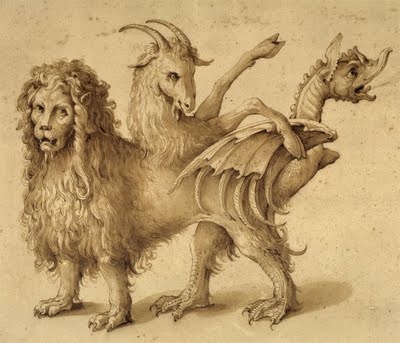
Notes on Chimerae

9e9626fd1b7c686e1047e7c950a6b139

Lorenzo, please do not eat my balls for this. This is the best I can do. I appreciate it is full of holes. I am coming to think that my teachers and forerunners are fucking idiots.

Taxas Vitae

Lit “Taxonomy of Life”.

Canonical “chant”/mnemonic – “Degenerae, Chimerae, Augmentus, Constructae, Naturalis, Metamorphae, Abominae” (earliest in Mercan? copied widely)

  • Degenerae – as Naturalis, but in some sense decayed or corrupt. Mercan “that function despite holes in their tubes” but that’s bollocks.
  • Chimerae – as Naturalis, but multiple forms combined. Telltale – it’s a horse but also a rat, etc.
  • Augmentus – as Naturalis, but things fused or grafted. Telltale – discernable joins.
  • Constructae – beings created from inanimate matter by beings of order Naturalis. Telltale – looks like shit (nullogenesis is hard).
  • Naturalis – ordinary living creatures of explicable biology, that is “those that are systems of tubes”.
  • Metamorphae – beings that have been transformed and are no longer what they were. Telltale – never quite complete. Always something left unchanged.
  • Abominae – “things that should not be”. Telltale – freaks you out, I guess.  Mercan -“Of this as a class, nothing can be said – each individual is unique.” (really?). Pleased, anyway, that Lichen is in here – hate that shit.

Taxas Chimerae

Guess this is what you really want…

  • Dispermic – the vile offspring from a union of two creatures. Vulnerable to – acid, as acid separates parts.
  • Chymical – two creatures fused together through dissolution, then reformed. Vulnerable to – salts as they were born of a liquid.
  • Sanguine – blood of two creatures in one set of tubes. Vulnerable to – fire as each blood has its own boiling point.
  • False – not a chimera at all – naturally that way, augmented by grafts, or constructed in likeness of a chimera. No vulnerability.

Bad news – if the chimeric types have telltale signs, there’s nothing in the books about it. We could write one? You could pay me to write one while you do the fieldwork?

Your faithful servant,

Turm Hedget, student, School of Acidic Patterns, 15 Nov 674


News in Immergleich, 15 November 935

… Sparked by the von Korps murder of a House Verdun watchwoman, the two houses fought street to street with many deaths on both sides. House Verdun were driven  into the security of their estate walls by the ferocity of the von Korps “enforcers”, in the morning the von Korps found they were trapped by an abstract painting of a lock across their mighty wooden gates, and paintings of sharp spikes along their high-city-facing walls. As yet unable to undo this art magic, they are reduced to entering and leaving by way of their back stairs into the Smoke.

House von Korps blames the murder on three burglars from the low city – a difficult-looking woman, a battered-looking veteran, and a wild-eyed man with an unkempt beard – although the reason for this charge is unclear. The von Korps have offered a bounty of 100 sp each for the apprehension of these ne’er-do-wells.

During the chaos, a cart being moved by von Korps soldiers overturned on the high city promenade, spilling half a dozen bodies. Witnesses were conflicted as to whether they were alive or dead. …